Non-fatal strangulation: there is no safe way
You may have arrived on this page because you were searching for terms such as ‘choking during sex’, ‘breath play’, ‘is choking safe?’ or ‘non-fatal strangulation symptoms’.
Although “choking” is a commonly used term, we use the term “non-fatal strangulation”, because it more accurately describes what happens when pressure is applied to the neck. Whatever it is called, there is no safe way to strangle someone.
What is strangulation?
Strangulation is when someone puts pressure on another person’s neck. This pressure can crush the blood vessels and airway, reducing the blood and oxygen that reaches the brain.
It can happen in different ways:
- with a hand or hands around the neck
- in a headlock
- with something wrapped tightly, like a scarf, belt, or rope.
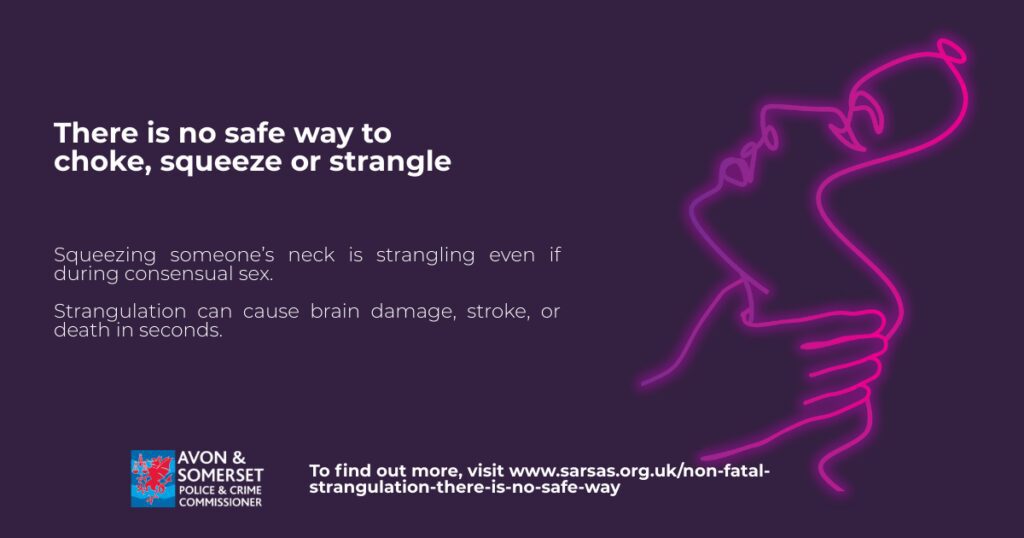
There is no safe way to strangle someone. Even if it’s done “lightly” or “just once”, strangulation is always serious.
What are the risks?
Some people believe strangulation is safe because of what they’ve seen in porn or heard from friends. But the risks are real, and signs of harm can appear minutes, hours, days, or even months later.
It can cause injury to the blood vessels in the neck, vocal cords, stroke, brain injury or even death.
- There may be no marks. Most people who experience strangulation do not have visible injuries, but internal damage can still be significant.
- Symptoms can be delayed. Voice changes, difficulty swallowing, dizziness, headaches, memory problems, or feeling “not quite right” may show up later.
- It affects the brain. Restricting blood and oxygen can cause acquired brain injury (ABI), strokes, seizures, or blood clots.
- It can be fatal. People have died hours, weeks, or even months after being strangled.
There is no safe way to strangle someone – ever.
What should I do if it has happened to me?
If you’ve been strangled in the last 72 hours, it’s important to get medical help immediately, even if you do not have any obvious symptoms. Doctors can check for internal injuries and may recommend a scan of your neck and head.
Seek urgent medical attention (call 999 or visit A&E) if you have:
- trouble breathing or a new cough (especially coughing up blood)
- dizziness, fainting, seizures, or have passed out
- voice changes or difficulty speaking
- pain or swelling in your neck or throat burst blood vessels in your eyes or tiny red/purple spots on your face or neck
- weakness, tingling, or numbness on one side of the body
- vision changes or a drooping eyelid
- difficulty walking or coordinating movements
- confusion, memory problems, or changes in behaviour
- thoughts of harming yourself
- been strangled while pregnant.
Whether it happened once or many times, recently or years ago, you can still speak to someone.
You can talk to your GP or call the NHS non-emergency medical helpline on 111 if you are worried about health impacts from strangulation. You will never be wasting anyone’s time.
What if someone strangled me without asking?
What happened is not your fault. It is not ok and you deserve support.
Strangulation is illegal, and you can report it to the police if that feels right for you. Support is available whether you choose to report to the police or not.
You can talk to SARSAS for confidential help and information.
What if I want to do it?
There is no safe way to strangle someone. No technique makes it risk-free. The danger is always there, including risks that can’t be seen or felt at the time.
What if someone wants to strangle me?
Even if someone asks for it, the law is clear: a person cannot consent to serious harm. If someone is injured during strangulation, the person who did it may be committing a criminal offence, even if they did not mean to.
In England and Wales, Section 70 of the Domestic Abuse Act 2021 covers non-fatal strangulation.
If found guilty, a person could face up to five years in prison.
Is it ok if there are no marks?
It’s common for there to be no visible injury. Around half of all people who are strangled won’t have visible marks on the outside.
Visible signs don’t indicate how serious it was. Internal injuries can be hidden, and people have died from strangulation without showing any marks.
Where can I get more information or support?
If you are in danger please call 999 the police emergency number immediately.
If you are not in immediate danger but would like to report a crime then you can do so via 101, the police non-emergency number.
There are organisations who will listen, believe and support you whether you choose to report or not.
SARSAS is a specialist service that supports anyone who has experienced any kind of sexual violence or abuse, at any time in their life. They provide a range of in-person services, alongside a helpline, e-support and live chat.
The Bridge is the Sexual Assault Referral Centre (SARC) for Avon and Somerset. They offer medical care (including forensic testing), emotional and psychological support, and practical help to anyone who has been raped or sexually assaulted.
Next Link provides domestic abuse safe accommodation and community support across Bristol, South Gloucestershire and North Somerset.
Institute for Addressing Strangulation (IFAS) provides a range of information and resources
If you are a professional looking to build your knowledge and understanding of non-fatal strangulation, we offer a range of training options to suit your requirements. Visit our training page for pricing and availability.
This campaign is supported by The Office of the Avon and Somerset Police and Crime Commissioner